To prevent failures in multi-agent systems, developers should focus on distributing tasks among agents, as architecture plays a critical role in success.
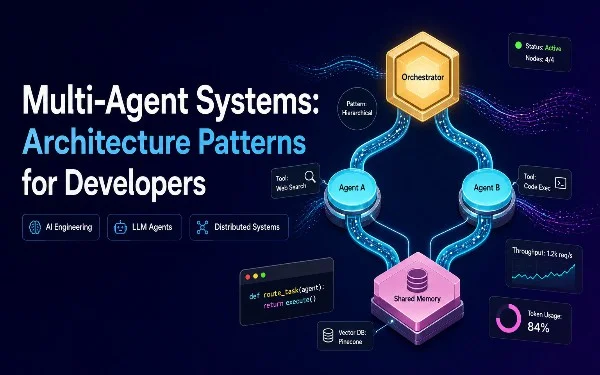
The Challenge of Overloaded Single Agents
Many agent-based production projects stumble not due to weak models but because they burden a single agent with excessive responsibilities. These agents are not just performing simple tasks; they're tasked with routing, planning, tool use, memory, and error recovery, all within an increasingly complex prompt. This overloading often leads to inefficiencies and errors, diminishing overall performance. The consequences of such challenges often extend beyond technical failures. They can also lead to organizational frustration, loss of time, and wasted resources that could have otherwise been allocated to more productive endeavors.
The concept of distributing tasks among multiple coordinated agents is one that has been explored in various fields. In robotics, for example, multi-agent systems have proven effective in managing complex environments where individual agents can focus on specialized tasks rather than being overloaded. In this context, shifting responsibilities to different agents can often result in a more streamlined and effective system. However, this shift doesn’t come without its own challenges. Ensuring effective communication and coordination between agents is critical; otherwise, the system risks descending into chaos, negating any benefits of distribution.
This not-so-simple progression reflects an ongoing trend in technology: specialization over generalization. By 2026, this pattern will be evident in nearly all engineering retrospectives, wherein teams will likely reflect on the inefficiencies of their previous single-agent dependencies. Adopting a more collaborative approach will be essential—and yet, achieving harmony among agents is no small feat. Coordination requires complex algorithms, state management intricacies, and shared knowledge bases, adding another layer of complexity to any project.
Growing Adoption and Persistent Failure Rates
Data highlights a notable trend: Gartner indicates that around 80% of enterprise applications shipping or updating by early 2026 will incorporate at least one AI agent. This is a significant rise from just one-third in 2024, reflecting an accelerated embrace of AI technologies by organizations. The motivations here are clear: companies are looking for efficiencies and the opportunity to automate routine tasks to focus human talent on higher-value activities.
Despite this surge, research from IDC and Forrester reveals a stark reality—about 88% of these projects fail to transition from pilot to production. This is troubling. It indicates that while enterprises are eager to adopt AI agents, many are stumbling at the implementation stage. The underlying issues often stem from orchestration challenges, data access limitations, and evaluation gaps. These technical barriers can hinder even the best AI initiatives, suggesting that architecture rather than model choice is pivotal in determining success. Strong architectural decisions can provide a solid foundation for robust systems and workflows, while poor architecture can quickly turn promising projects into costly failures.
Moreover, orchestration challenges highlight that deploying a single agent isn’t enough. Companies need to consider how various AI agents will integrate with existing IT systems and workflows. Without a well-defined orchestration strategy, agents may operate in silos, failing to deliver the synergy they’re supposed to enhance. Such fragmentation can lead to duplicated efforts, inefficiencies, and even inter-agent conflicts—ultimately adversely affecting the user experience and the organizations' bottom lines.
Technical Hurdles in Implementation
The technical barriers to successful implementation often revolve around data access and quality. AI models rely heavily on high-quality data for training and ongoing operation. When that data is fragmented across diverse sources with inconsistent formats, it can reduce the effectiveness of AI agents drastically. Many companies have data silos where useful information is trapped and inaccessible to the AI systems. Addressing this requires not only sophisticated data integration techniques but also a cultural shift within organizations that prioritize data sharing and collaboration.
Another significant hurdle lies in evaluation gaps. Organizations often lack metrics or frameworks to adequately assess the effectiveness of their AI projects. Many initiatives may initially appear successful in controlled environments but struggle when scaled. The results from pilot tests rarely translate neatly into real-world outcomes. Companies need a clear understanding of what success looks like and how to measure it throughout the lifecycle of an AI initiative.
Implications and Future Outlook
The implications of these trends in agent-based AI are profound. If you're working in this space, recognizing that merely implementing a single AI agent won’t suffice is critical. It means you need to rethink management structures, communication protocols, and data architectures from the ground up. As organizations increasingly migrate to multi-agent systems, the demand for professionals skilled in AI orchestration, architecture, and inter-agent communication will rise sharply.
It’s also essential for organizations to cultivate a mindset that embraces continuous learning. The successful deployment of AI agents isn’t just a one-off project; it’s an ongoing commitment to refinement and adaptation. This shift has the potential to redefine how companies approach technology projects entirely. The move from overloaded single agents to more collaborative multi-agent systems promises improved efficiency, but beware—this transition will require significant rethinking and reworking of existing practices and mindsets.
As we move closer to 2026, businesses will need to better equip themselves for the complex interplay between agents. The future is not about isolated AI capabilities, but rather how those capabilities can work in concert. And let’s be clear: navigating this complexity will separate the leaders from the laggards in the AI space.



Discussion
Sign in to join the discussion.