The GD01 by Unitree Robotics signals a pivotal shift in robotics, emphasizing versatile mobility and intelligent task execution over mere movement.
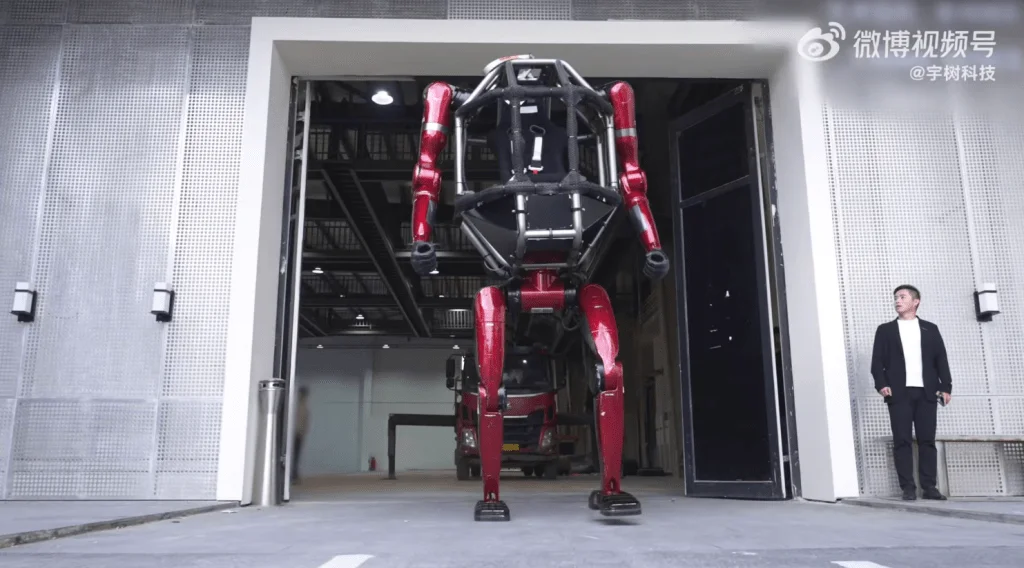
Unitree Robotics has positioned itself at the forefront of the robotics industry with its recent unveiling of the GD01, a manned mech that made headlines by appearing on the cover of TIME magazine. This 2.7-meter-tall machine illustrates a significant leap in robotics, showcasing the industry's transition from basic movement capabilities to more complex integrations of intelligence and versatility.
Claimed to be the world’s first mass-produced manned mech, the GD01 weighs about half a ton and operates from a cockpit located in its torso. It can adapt its movement style, switching seamlessly between bipedal and quadrupedal locomotion, powered by red mechanical legs reinforced with heavy-duty mechanical hinges. Its fists are reported to be powerful enough to break through walls, emphasizing not just utility but also strength.
While earlier robots produced by Unitree were largely employed for research, educational, and industrial purposes, the GD01 signifies an exploration into how robots can function within more dynamic and challenging environments. This shift signals a departure from single-purpose machines to versatile platforms capable of a diverse range of actions.
The initial market response to GD01 was reminiscent of scenes from sci-fi movies, but the deeper significance lies in its implications for the future of the industry. The emphasis is shifting towards what these machines can accomplish rather than simply how they look. Rather than fitting neatly into the categories of industrial or consumer robots, the GD01 serves as a platform designed for intelligent mobility across varied scenarios.
Its ability to maneuver in three different modes grants it an advantage in complicated terrain, indicating potential applications in diverse fields such as emergency rescue, hazardous inspections, and transportation. Unlike conventional robots that depend on specific pathways or highly structured environments, the GD01 aims to extend robotic presence into uncharted locales.
This direction aligns with the challenges facing robotics today: the need for more advanced motion control and intelligent interaction that enable robots to thrive in real-world situations. It’s not enough anymore for robots to just mimic human movement; the focus is now on their capacity to perform practical tasks that deliver tangible benefits.
As China's robotics sector continues to evolve, marked by increased competition and rapid growth, it's clear that the focus is shifting away from mobility alone. Companies are now challenged to create machines that can understand their environments and execute meaningful tasks. This evolution is accentuated by Unitree's trajectory, which has established its leadership through diverse product lines, from robotic dogs to humanoid robots.
As more firms enter the race for embodied intelligence, the essential question has shifted: the challenge now isn't just getting robots to move, but ensuring they can provide real economic value in applications ranging from logistics to manufacturing. These requirements signal a fundamental change in the development of robotic technology.
The GD01 exemplifies this new paradigm by integrating sophisticated mechanical structures with advanced control systems, indicating a broader industry trend towards creating intelligent machines that can operate effectively across multiple environments. Competition in robotics is no longer measured solely by speed or hardware specifications; the real differentiators will be a robot's ability to read its surroundings and leverage AI for operational tasks.
While the GD01 may not reach the highest sales figures, its significance lies in how it reflects the technological evolution of China's robotics landscape. It serves as an illustration of the ongoing journey from laboratory experimentation to practical application in everyday life.
Nonetheless, significant obstacles still need addressing, such as safety standards, manufacturing costs, and battery efficiency. Questions around how to reduce production expenses, gather actionable data through prolonged use, and develop comprehensive safety protocols remain focal points for the industry.
As we look ahead, sectors like industrial production and emergency services stand out as the likely grounds for robotic deployment. The narrative in robotics is unmistakably shifting: having focused on enhancing mobility for a decade, the coming years will emphasize how to infuse real value into robotic capabilities.



Discussion
Sign in to join the discussion.