Mastering Kubernetes Probes: Enhancing Application Stability with Effective Health Checks
Published Sep 25, 2026Reads 702Desk Ahmed Tariq
Configuring liveness and readiness probes properly in Kubernetes is crucial for application stability, preventing unnecessary restarts and ensuring effective request handling.
Understanding Kubernetes Liveness and Readiness Probes
When deploying applications on Kubernetes, configuring liveness and readiness probes is essential. Failing to do so properly can lead to unwanted behaviors, as demonstrated by a case involving a Node.js worker that repeatedly restarted due to an incomplete environment setup.
Initially, the worker, which was designed to pull jobs from Redis but had no HTTP service to expose, attempted to use an exec-based liveness probe with the command `pgrep -f server/worker`. Unfortunately, the lightweight Node.js runtime image lacked the `pgrep` utility. This omission meant that Kubernetes interpreted every failed probe as a signal that the worker was down, leading to unnecessary restarts and ultimately a state of CrashLoopBackOff. This scenario highlights a critical lesson: liveness checks should not solely rely on process existence without understanding the broader context of application health.
Importance of Robust Checks
Relying on the presumption that `pgrep` alone could ensure operational integrity proved to be shortsighted. While `pgrep` might confirm that a process exists, it doesn't guarantee that the process can communicate effectively with Redis or handle tasks as expected. Simply verifying process existence does not address whether the worker can process jobs or if it's experiencing a deadlock due to external factors. The overreliance on such basic checks can foster a false sense of security regarding the application's performance and reliability.
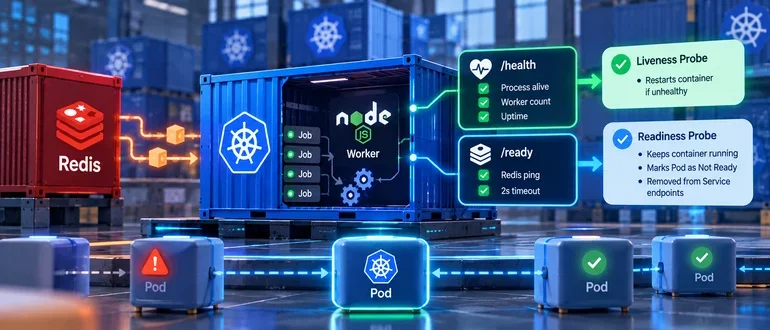
To remedy this, developers introduced a new HTTP endpoint for health checks, aptly named `/health`. This endpoint was designed to respond whether the Node.js worker could accept requests while intentionally avoiding direct interactions with Redis. The response would include metrics like uptime and the number of active worker processes, but it stopped short of confirming whether those workers were successfully processing jobs. This refinement minimizes risk; a Redis failure won't cause mass restarts, which could worsen system stability.
The introduction of the HTTP health check marks a move toward a more fail-safe approach. After all, in many cases, the true operational health of an application is about more than just running processes—it's about their ability to sustain interactions with dependencies. Moreover, by focusing on health checks that actively engage with the application’s environment, developers get a clearer picture of the true state of their application rather than relying on potentially misleading signals.
The Role of Readiness Probes
The readiness probe, in contrast, is tasked with assessing whether the worker can serve requests rather than simply existing. This probe actively pings Redis with a defined timeout to ascertain connectivity. If the Redis server is unreachable, the worker returns a 503 status indicating it's not ready to handle requests. However, it's crucial to understand that Kubernetes’ control over readiness does not inherently prevent job consumption from Redis during such failures. The worker still needs to have internal logic to manage its job queue independently from the Kubernetes proxy.
This distinction is vital. If a worker, such as the one discussed, must stop consuming new jobs when experiencing issues, it needs to effectively manage that through its application logic, rather than relying solely on Kubernetes readiness signals. This internal logic becomes even more critical in complex systems where external dependencies have a cascading effect on service availability.
What this means for you, especially if you're working in this space, is that you can’t delegate operational concerns solely to Kubernetes. The application must remain resilient and capable of responding intelligently to its environment to maintain throughput and stability during outages.
Testing and Verification
For developers operating in this domain, testing these probes under realistic conditions is not just beneficial; it’s essential. Running each exec probe in the actual production image, simulating Redis outages, and ensuring that pod states reflect the application’s actual capability to work should become standard practices.
Here’s the thing: one test should verify that a failure in Redis connectivity updates the readiness state without causing a restart of the worker. This emphasizes that recovery logic lies within the application itself. Automated tests can help prevent deployment issues that spiral into significant downtime; treating health assessments as key performance indicators can lead to better decision-making in operational management.
Beyond the technical checks, there lies an aspect of operational culture among development teams that can’t be ignored. Regular reviews of probe configurations and their impact on application health can foster an environment where teams take external dependencies seriously. Monitoring should be proactive, not reactive.
Future Outlook: The Implications of Probes on Application Resilience
As applications become increasingly microservices-oriented, the need for effective liveness and readiness probes will only grow. In a world where systems are interdependent, your ability to manage failure at the application level becomes paramount. The right probes can dramatically affect recovery time and service availability.
Here’s a sobering thought: overlooking these checks can lead to systemic issues spanning multiple services. Reducing the dependency on Kubernetes for operational oversight could lead to both improved application reliability and reduced downtime. Developers will want to keep an eye on how tooling evolves, especially concerning observability.
As cloud-native architectures become more common, there’s an increasing expectation for teams to take full ownership of application health. This isn't merely about ensuring that pods are running; it’s about the overarching narrative of application performance. Being vigilant about probes today helps lay the groundwork for robust systems tomorrow.



Discussion
Sign in to join the discussion.