Enhancing Kubernetes Remediation: Beyond Simple Success Indicators in AI Operations
Published Sep 15, 2026Reads 541Desk Vasuki Uday Kiran Vudathala
Successful AI-driven Kubernetes commands require careful validation; true remediation hinges on thorough checks of state changes, not just tool success.
The Challenge of Inferring Success in AI-Driven Kubernetes Remediation
Understanding the limitations of current AI agent capabilities in Kubernetes remediation is essential. The prevailing misconception is that a successful tool call automatically means the remediation worked. However, that’s a dangerous oversimplification. Just because a Kubernetes command reports success doesn't guarantee that the conditions in the cluster have changed as required or that the application is functioning as intended. This misinterpretation can lead to unforeseen issues, with operators left in the dark about the actual state of their systems.
Here's the crux of the issue: Successful execution of a command is only the beginning. An autonomous agent needs far more than a “success” response to ensure proper cluster management. It requires a detailed series of checks to verify that the intended outcomes have been achieved. Without this verification, the risk of acting on incorrect assumptions becomes significant. A single green light can mask deeper issues lurking in the system, creating a false sense of security.
The Four Crucial Checks
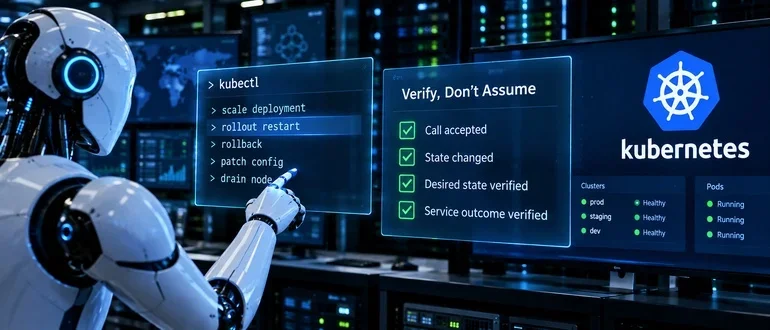
Four distinct checks must be completed to ensure reliable outcomes from AI operations in a Kubernetes environment:
1. **Call Accepted**: The first hurdle is confirming that the control plane received the action request. Network issues, timeouts, or dropped requests can lead to ambiguity about whether the command even reached its destination. Quite often, operators naively assume success based solely on a returned status without checking the chain of communications. It's vital to prioritize logging and monitoring that can fill in these gaps.
2. **State Change Verification**: After confirming that the call was accepted, the next step is to ensure that the state actually changed and only once. If the operation isn’t idempotent and the command succeeded without a clear acknowledgment, an agent may mistakenly assume that it accomplished its goal and retry the action, potentially causing disruptions. This step requires a clear understanding of the Kubernetes object states and their transitions, which is often overlooked in speed-driven environments.
3. **Desired State Confirmation**: Transitioning to the desired state is not just a single step; it demands verification that the actual state matches the intended configuration. Even if a rollout command reports success, only a thorough re-evaluation of the cluster can clarify whether it settled into the desired state. Operators should regularly check this alignment—misalignments could signal deeper troubles in application performance post-deployment.
4. **Outcome Validation**: Finally, we must assess whether the application itself has recovered effectively. Observations show that a “green” status from Kubernetes doesn't necessarily equate to a healthy application lifecycle. For both the agent and operator, the real issue isn’t just achieving a state but ensuring that it aligns with user expectations and real-world behavior. The trouble emerges when operator satisfaction metrics are eventually disregarded in favor of technical indicators.
What this means for those integrating AI into their Kubernetes operations is clear: an angle of oversight must be introduced. Success shouldn't merely be a qualitative judgment; it demands a series of verifiable claims that are continuously monitored against live data. The efficacy of AI agents can only be assessed if there’s a feedback loop that accounts for both their actions and the actual environmental impact of those actions.
Moving Beyond Tool-Success Indicators
The conversation can't simply stop at tool call returns; there’s a nuanced gap between what an AI agent perceives as success and the actual outcomes desired by the human operator. For instance, an agent may successfully stop a loop of application crashes by reducing the deployment to zero. Technically, the intention behind stopping the errors has been met, but it inadvertently takes the application offline—a clear failure on the operator’s end.
The lesson here is that verification processes need to involve independent service health signals, such as error rates, latency against service-level objectives (SLO), or user-interaction metrics. This shift ensures that AI agents don’t just track internal expectations but align closely with the operational targets set by their human counterparts. You can’t afford to overlook the distinct processes that define application health from an operational perspective.
Ultimately, while agentic operations are making strides in Kubernetes, it’s vital to recognize that success can't simply be inferred from tool responses. If you're working in this space, ensure that any agent deployed is backed by a strategy for validating outcomes. The real challenge lies in bridging the gap between machine functionality and human intent—any solutions should focus on verification mechanisms that accurately capture what happens in the wake of each AI command.
Implications and Future Outlook
The implications of unverified success in AI-driven Kubernetes management extend beyond immediate operational concerns; they affect long-term viability. Companies may face increased downtime or degraded performance if root causes aren't identified, leading to wasted resources and diminished customer trust. It's essential for organizations to recognize that the automation of remediation tasks, while beneficial, must incorporate a mindset that favors thorough verification over blind automation.
You might wonder about the future of AI in this domain. As systems become more complex, the interplay between machine capabilities and human oversight will increasingly define success metrics. Developers and infrastructure teams must rethink traditional approaches to monitoring and alerting, integrating AI-driven insights that provide clarity rather than ambiguity. Going forward, those best positioned to succeed will prioritize checks and balances that align AI actions with tangible business outcomes.
The machinery of AI in Kubernetes is operating at a critical juncture. The technology's potential is massive, but it relies on careful strategic execution to realize it. This isn't just about improving efficiency; it's about ensuring that the infrastructure remains robust and responsive to real-world challenges.



Discussion
Sign in to join the discussion.