Explore how misalignments between autoscaling and container scheduling can hinder efficient resource management in cloud environments.
The interplay between autoscaling and workload scheduling is critical in cloud infrastructure management. When managing Docker Swarm with Azure Virtual Machine Scale Sets (VMSS), it's easy to assume that an autoscaling system is operating correctly just because it's actively responding to resource demands. However, my recent testing revealed a significant disconnect between what the autoscaler observes and the actual scheduling pressures experienced within Docker Swarm. This gap can lead to serious inefficiencies, as systems that seem to function adequately on the surface could be hiding deeper issues that ultimately affect performance and reliability.
Initial Testing Validates Autoscaling
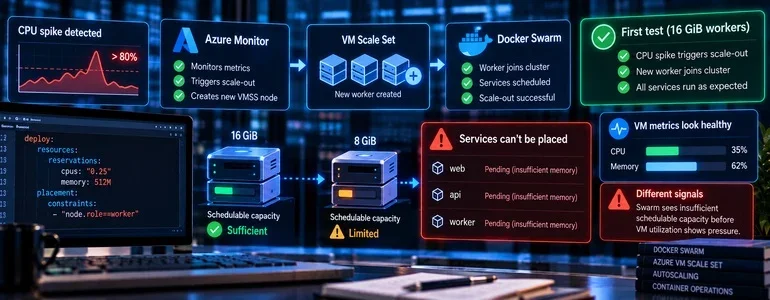
During initial tests, our autoscaling setup performed as expected. Using Azure Monitor, we tracked key metrics such as CPU usage, memory consumption, and task queues. A CPU spike triggered the creation of an additional worker, affirming that scaling-out was functioning smoothly. The testing environment operated as designed, showing a fluid addition of resources in response to increased demand. But here's the thing: this initial success sets a potentially misleading precedent about the capabilities of the system. Just because the autoscaler activated additional resources doesn't guarantee that the workload would be balanced effectively across those resources.
Downsizing Exposes Scheduling Limitations
However, when we downsized our worker configuration from 16 GiB to 8 GiB, a different issue emerged. Even though we maintained existing service reservations, several services failed to start as they couldn't find sufficient schedulable capacity. This created a frustrating bottleneck that highlighted how scaling down doesn't just involve cutting resources; it requires a detailed analysis of how those remaining resources can be repurposed. Interestingly, the autoscaler didn't recognize this limitation since VM-level metrics still indicated adequate resources. This disconnect is particularly dangerous. While the autoscaler is focused on broad resource usage metrics, the actual scheduling pressures faced by Docker Swarm are nuanced and complex.
This experiment highlighted an essential realization: while host utilization data and schedulable capacity share a relationship, they communicate distinct needs. The autoscaler was not aware of the scheduling crisis unfolding within the cluster. And yet, this discrepancy can have dire ramifications. Ignoring the specific requirements of each service not only leads to inefficiencies but can also negatively impact application performance and user experience. If you're working in this space, you need to understand that autoscaling must be more than just responding to metrics; it has to account for the actual demands of the workloads involved.
Understanding Resource Reservations
Resource reservations shape how the scheduler allocates resources. For instance, a memory reservation doesn't imply that the resource is constantly in use; it merely indicates that a task requires a certain amount of memory to be available for it to launch. This fundamental distinction can create confusion for teams relying heavily on standard performance metrics. As a result, the autoscaler may perceive the infrastructure as sufficiently provisioned, while the scheduler may find itself incapable of placing tasks appropriately. This mismatch can result in unfulfilled service requests and an overall degradation of system performance.
This discrepancy between Azure Monitor's view and Docker Swarm's scheduling rules became evident during testing. The autoscaler monitors overall health metrics, whereas the Swarm scheduler focuses solely on committed resource reservations and their availability. The outcome is a lack of synchronized understanding between the two systems. Oftentimes, this lack of alignment can lead to costly miscalculations regarding resource deployment, which can significantly slow down service delivery and ultimately frustrate users.
Revising Autoscaling Tests
The takeaways from these tests necessitate a reassessment of autoscaling strategies. The goal should not merely be to react to CPU spikes or memory thresholds but to deeply understand the dynamics of task scheduling. Teams must prioritize a holistic view that encompasses both system metrics and scheduling realities.
- Verify that every required task can be scheduled at the minimum worker count.
- Assess the impacts on schedulable capacity when resizing worker nodes, particularly in terms of application performance.
- Identify which specific metrics trigger infrastructure scaling. This isn’t just about resource usage; it's about understanding the flow of applications.
- Ensure that those metrics react quickly enough to preemptively address pending tasks, allowing for an agile response to changes in demand.
Implications and Future Outlook
Looking ahead, the implications of improving the synergy between autoscaling and workload scheduling are significant. Companies that successfully align these processes can enhance their cloud resource efficiency, reduce costs, and create a more responsive service environment. As cloud architectures continue to be integral to business operations, this alignment is set to become a focal point for organizations aiming to maintain competitive edges in their fields.
Moreover, getting this right can lead to improved overall system reliability. An integrated approach ensures that not only are resources available when demand peaks, but that they are effectively utilized to maximize operational efficiency. As adoption of container orchestration systems continues to grow, organizations will increasingly need to rethink their infrastructures and integrate smarter autoscaling strategies.
Conclusion: Synchronizing Autoscaling and Scheduling Policies
The intersection of autoscaling and workload placement necessitates collaboration between infrastructure management and orchestration tools. It's essential that these two systems communicate effectively to ensure that the observed metrics truly reflect the pressure on resources. When only relying on host-level data, we risk misjudging the actual operational demands of our workloads.
In practice, the most valuable autoscaling signals often stem from the scheduler pain points rather than just high CPU or memory usage. By aligning both perspectives, teams can devise more effective scaling strategies that not only allocate resources based on demand but also recognize and respond to the underlying task placement challenges. The future of cloud management will be defined by those capable of mastering this interplay, effectively transforming potential liabilities into operational triumphs.



Discussion
Sign in to join the discussion.