Enhancing Software Security with Container Image Signing in CI/CD Pipelines
Published Oct 08, 2026Reads 559Desk Michael Carter
Container image signing is crucial for ensuring the integrity and authenticity of software artifacts throughout the deployment process.
Understanding Container Image Signing: A Critical Component in Secure Software Deployment
When we talk about security in the software deployment process, it's easy to focus solely on the immediate steps in the CI/CD pipeline. But here’s the thing: just because an image passed every test during development doesn't mean it’s trustworthy by the time it hits production. The reality is that a build might be successful, vulnerability scans might come back clean, and the image might be stored in a reputable registry—yet none of that guarantees that what’s running in production is precisely the artifact intended by the organization.
This disconnect signals a dramatic gap in traditional deployment security. Enter container image signing. It’s not merely a procedural step; it’s an essential safeguard that links cryptographic evidence directly to the software artifact. This facilitates a crucial verification process within deployment systems that can determine the validity of an image and the authority of its signer. Understanding this process is vital for any DevOps professional navigating today's complex release environments.
The Importance of a Trusted Deployment Pipeline
Picture this: your CI/CD pipeline generates an image that meets all the benchmarks for quality and security. However, if the deployment chain lacks the ability to verify the source of that image, the organization remains vulnerable to trust issues at deployment time. The core question shifts from whether the pipeline created a correct image to whether the environment can confirm the integrity and origin of that image. As organizations embrace automated Kubernetes deployments and adopt modern CI practices, this distinction is more important than ever.
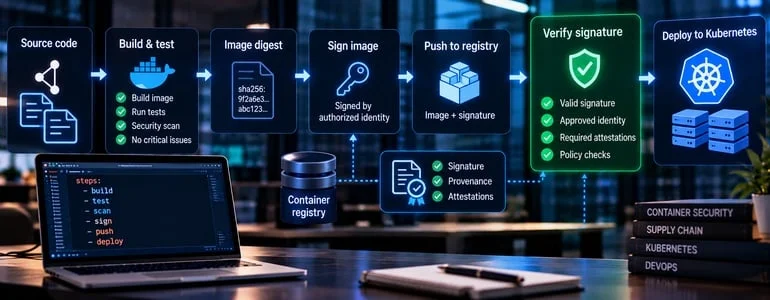
The workflow for implementing container image signing isn't as linear as one might think. It isn't just a cherry-on-top operation; rather, it’s an intricate thread that ties together various stages—source code, build environments, cryptographic infrastructure, and deployment policies. Every step relies on verifying that the artifact remains linked to its signing evidence at each phase of the deployment process. This connection is instrumental in building trust in a landscape where ephemeral build runners and automated deployments have become commonplace.
Beyond CI/CD: Container Security Requires More Than Tags
You might think that container registries solve the fundamental problem of distribution, and to some extent, they do. They serve as centralized repositories from which systems retrieve images. However, having access to a registry doesn't automatically correlate with assurance in the authenticity of the artifacts it houses. Consider this: an authenticated user could inadvertently or maliciously push an unauthorized image. The same can be said for potentially compromised CI credentials.
Cryptographic signing provides a safeguard against such scenarios. By embedding evidence about the artifact itself, organizations can enact stringent deployment policies that require signed images from approved identities, mandate separation between development and production signing, and reject images that are unsigned or not properly validated. The goal isn't to elevate trust in one single source; it's about creating layers of verifiable evidence that inform decision-making at the point of deployment.
In essence, image tags are not security boundaries. While they are invaluable for version management, they can be easily manipulated. A tag pointing to a specific manifest can shift under different circumstances, making it ineffective as a standalone measure of trust. This highlights the need for a security framework that moves beyond tags to digests and signatures, leading to a comprehensive understanding of what gets deployed and why.
In summary, as we integrate strategies like container image signing into our DevOps practices, we enhance the integrity of our software delivery pipelines. This isn't just an additional step; it's a fundamental shift toward ensuring confidence in what we deploy to production.
The Future of Trust in Software Delivery
As we wrap up our exploration of container image signing, it's evident that the implications extend far beyond a mere cryptographic seal. Connecting the dots from the build pipeline to the deployment environment, we uncover a larger narrative about trust and security in software delivery. Implementing effective image signing isn't just about compliance; it’s about embedding trustworthiness into the very foundation of your deployment architecture.
Consider this: while a valid signature indicates that an artifact has not been tampered with and indeed hails from an approved source, it does not mean that the underlying image is immune to vulnerabilities. This distinction is crucial for any team operating in modern DevSecOps environments. As you look ahead, the challenge isn’t merely about signature verification. It's also about creating an interconnected web of evidence that captures not just who signed an artifact, but how it was built, what risks it carries, and its journey through the deployment pipeline.
Connecting the Dots for a Stronger Security Posture
The era of siloed security measures is fading. Effective container signing practices should operate in harmony with supply chain integrity checks, security scans, and provenance tracking. The more layers of verification you can apply—attestations, Software Bill of Materials (SBOM), and rigorous identity management—the better positioned you are to make informed deployment decisions.
If you're managing a DevOps team, this is a pivotal moment. The evolution toward a comprehensive security posture means treating image signing as part of a bigger framework, rather than an end-point solution. You’ll want to integrate the various mechanisms at play to ensure that every component of your deployment process contributes to a holistic evidence chain. Not only does this approach bolster compliance, but it also enhances your organization’s resilience against potential supply chain attacks.
In essence, the road ahead requires that we rethink how trust operates within our software ecosystems. By demanding more than just signatures, and holding our processes accountable at every stage, we can build a fortress against threats—ensuring that each deployment is not just a leap of faith, but a calculated, verified action within a fortified framework.
In conclusion, embracing the full spectrum of verification and control measures transforms container signing into an indispensable part of a secure, agile software delivery pipeline. For those on the front lines of DevOps, this should be your takeaway: trust isn’t automagically granted by a signature; it must be constructed, layer by layer, across the software supply chain.



Discussion
Sign in to join the discussion.