Containerization can mitigate permission fatigue in AI coding agents, improving security by limiting access and reducing risks associated with excessive privileges.
## The Risks of Permission Fatigue
Permission fatigue presents a significant threat in the context of AI coding agents. With repeated prompts for approval blurring the line between caution and routine, developers find themselves mindlessly clicking "approve." This practice can inadvertently grant AI agents access to critical credentials, sensitive files, and systems with little thought to the security implications. It's an insidious way to erode safeguards as powerful tools navigate your environment, wielding the same permissions you do, including SSH keys and cloud access.
## The Role of Containers in Security
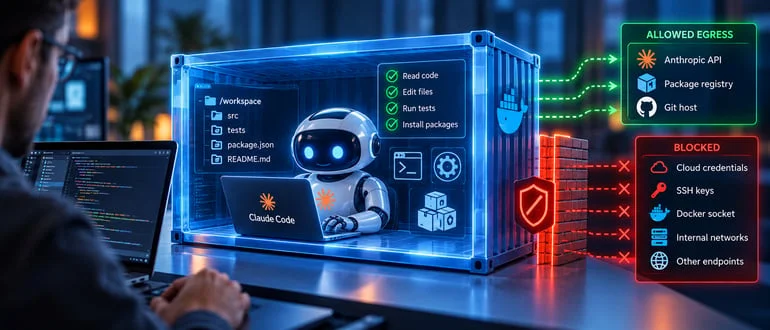
Containerization offers a compelling solution to this challenge. By confining autonomous coding agents to specific environments, containers establish strict boundaries that limit what these agents can access. Implementing policies around restricted mounts, non-root execution, scoped credentials, and controlled networks can substantially reduce potential risks. With this approach, developers can define what resources the agent interacts with just once in a reviewable configuration file, paving the way for a more secure workflow.
However, it's crucial to recognize that containerization isn't a silver bullet. Although it helps contain agents' actions within specified limits, it does not eliminate all security risks. Vulnerabilities related to shared workspaces and network connections, along with potential host-kernel exploits, require vigilant oversight and strategic security measures. The take-home message is clear: while containers enhance security, they must be accompanied by comprehensive security practices.
## Understanding Agent Requirements and Exposures
To maximize the efficiency of AI coding agents like Claude Code, developers must understand what these agents truly need to operate effectively. Essential requirements typically include access to the project source, relevant language toolchains, and package registries. By contrast, typical developer machines offer excessive privileges, such as long-lived tokens stored in directories like `~/.aws` or `~/.kube`, which are unnecessary for a task as straightforward as fixing a unit test. This disconnect poses a security risk, especially if an agent misinterprets an instruction or follows malicious guidance hidden in code comments.
To address this disconnect, containerizing the agent appears to be a prudent approach. Defining operational boundaries significantly minimizes the risk inherent in excessive permissions.
## Building a Secure Environment for AI Agents
When it comes to architecting a secure container environment for AI agents, four critical components dominate the configuration process. First, developers should focus on creating compact images that house the necessary toolchain while disabling self-updating functionalities, ensuring consistency across all user environments.
Second, it's vital to execute containers under a non-root user. Containerized AI tools often default to restrictive user policies, and maintaining these defaults prevents escalated privileges, which can lead to exploitable vulnerabilities.
Third, developers should limit the container’s access to only essential mounts—ensuring that sensitive directories remain untouched. Avoid binding entire home directories, as this can inadvertently expose critical credentials or configurations.
Lastly, implementing effective outbound traffic controls is essential. By default, all outbound connections should be denied, allowing only crucial endpoints for model inference and package management. This creates a controlled environment that minimizes risks of data exfiltration or malicious command execution.
## The Benefits of Containerization
The rationale for containerizing AI agents extends beyond mere security; it also enhances workflow efficiency. When missteps occur, damage remains confined to the project's directory, effectively containing fallout. This not only protects sensitive information but speeds up the recovery process.
Additionally, permitting agents to operate without constant permission prompts—within trusted boundaries—liberates them to tackle more extended tasks autonomously. The documentation for tools like Claude Code itself suggests that their no-prompt operation is best suited within a containerized or virtualized setting.
Moreover, using containerized environments ensures reproducibility. By locking down toolchain versions and agent configurations, teams can eliminate discrepancies in behavior across different machines, thus improving collaboration and troubleshooting.
New engineers benefit as well; onboarding becomes simpler when they can pull a standard image reflective of the organization’s configurations.
That said, it's worth noting that while containers provide significant improvements, they don't negate all risks. Proper precautions remain crucial to maintaining robust security, particularly concerning sensitive data and shared environments.



Discussion
Sign in to join the discussion.