Navigating the Challenges of Migrating Applications to ARM Architectures
Published Oct 15, 2026Reads 529Desk Garima Agarwal
Transitioning to ARM architecture requires more than just image builds; thorough testing and dependency audits are vital to avoid production failures.
Understanding the Risks of Moving Containers to ARM
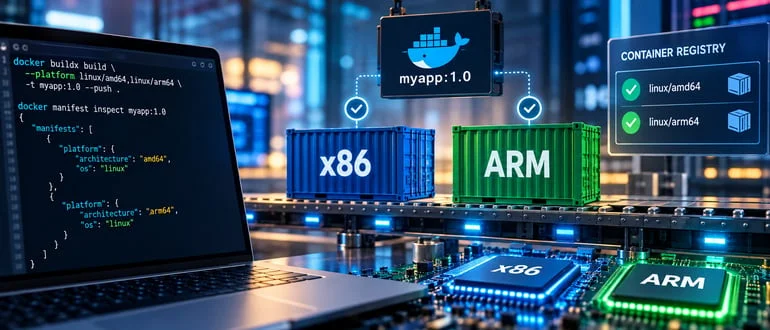
Transitioning applications from x86 to ARM architectures may seem simplistic—in theory, you merely append a platform flag to your build command. Yet, the reality is far more complex. Simply achieving a successful image build doesn't guarantee the application will run as expected on these new architectures. In actuality, while Docker can produce valid images for both amd64 and arm64, critical dependencies that are architecture-specific often lead to runtime failures that can catch teams off guard.
The Build vs. Runtime Dichotomy
It's crucial to realize that a successful build could mask underlying issues. The portability of application code doesn't extend to the binaries and dependencies that live beneath it. Problems often only surface at runtime, leading to crashes specifically on one architecture. These failures typically strike in production—the precise environment where their effects can be most damaging. When you factor in the reliance on production uptime, the stakes become significantly higher.
Without diligent testing on ARM hardware before deployment, many organizations risk encountering production outages, which could have been avoided with proper due diligence. That's an oversight you can't afford. Relying solely on build success might leave you unprepared for unforeseen architecture-related pitfalls.
The Architecture-Specific Dependency Problem
One of the greatest challenges in migrating to ARM is navigating architecture-specific dependencies. Many teams unknowingly utilize hardcoded downloads, incompatible libraries, or architecture-bound Java packages in their builds. These seemingly minor oversights can snowball into significant problems. They might lead to crashes or, worse yet, undetected performance issues that degrade service quality over time.
Here’s the thing: many environments focus too heavily on surface-level functionality. The complexities of architecture compatibility get overlooked, especially under tight deadlines. This makes it essential for teams to adopt a proactive approach. It's not merely about running CI/CD pipelines; actual ARM testing and deep dependency audits are vital to uncover potential migration failures. This entails rigorous examination of every package and library involved in the build process. Ensure to use tools that can accurately account for architecture differences, including audit checks before rolling out any service or application to ARM.
Key Pre-Migration Takeaways
1. **Inspect Docker manifests**: Confirm that images for both amd64 and arm64 are present. Without checking, you might unknowingly be working with a flawed image.
2. **Run tests natively**: Engage with ARM-specific hardware, rather than relying on emulators, for accurate results. Emulators can seem adequate, but they frequently fail to reflect true performance.
3. **Replace hard-coded architecture strings**: Utilize build arguments like `TARGETARCH` to dynamically fetch the correct binaries. This simple switch can save a lot of headaches down the line.
4. **Audit shared libraries**: Look inside ARM images to ensure no incompatible binaries exist, mitigating runtime failures. A thorough check now can prevent a lot of pain later.
Why Watch Your Build Pipeline?
Many build systems still predominantly operate on x86, leading to scenarios where ARM images are built and deployed without proper testing. The potential for mixed architectures increases the chances for confusion during deployment, which can lead to operational headaches. If you're working in this space, you'll realize just how daunting it becomes when workloads succeed on certain nodes but crash on others.
Without proper architecture enforcement in your CI/CD pipeline, you're creating a minefield of potential failure points. This can result not only in application downtime but also in a drawn-out debugging process that could have been avoided entirely with the right precautions.
Future Implications and Significance
As more organizations consider migrating to ARM architectures, the implications extend far beyond mere cost savings. This shift towards ARM is being driven by the growing recognition of its efficiency and performance benefits, especially for cloud and mobile applications. However, the technical hurdles outlined here can’t be ignored.
And yet, larger questions loom around the shift itself. What this means for you, as a developer or IT leader, is that there's a crucial balancing act between adopting advanced technologies and ensuring operational integrity. The dynamics of ARM adoption could reshape how teams approach multi-architecture strategies in the future, compelling a reevaluation of existing CI/CD practices.
As the tech industry moves toward ARM, organizations must stay accountable and vigilant. By addressing these factors now, you can set a foundation that mitigates migration headaches later on and capitalizes on the advantages that ARM can provide.

Discussion
Sign in to join the discussion.