Explore how headless configurations and Kubernetes empower WordPress scalability and flexibility for modern applications.
Rethinking WordPress with Headless Architecture on Kubernetes
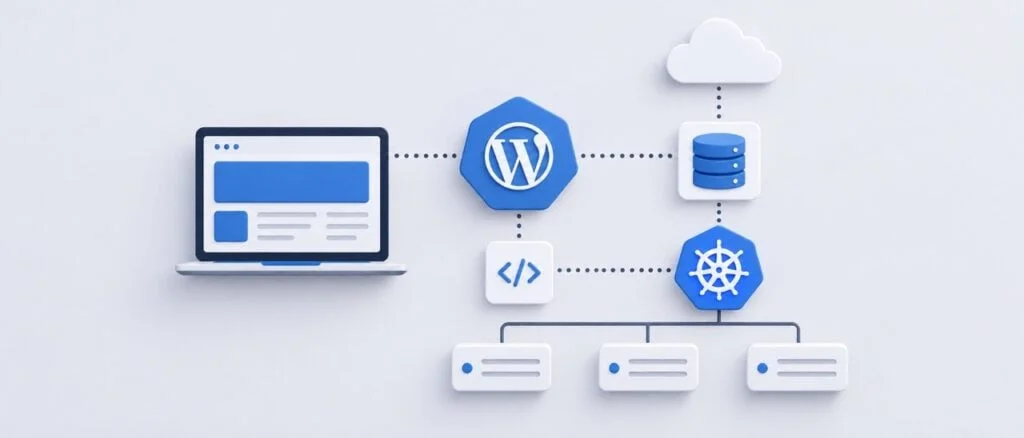
While WordPress has historically relied on traditional web server setups, the rise of Kubernetes and containerization presents a compelling opportunity to evolve its architecture. In a headless configuration, WordPress serves primarily as a content management system (CMS) and API provider, allowing front-end applications to operate independently. This separation can streamline development and enhance scalability, particularly for teams already leveraging cloud infrastructure.
The Case for Headless WordPress
Integrating WordPress with Kubernetes provides tangible benefits, but it’s not needed for every site. For small, static web pages, introducing a Kubernetes cluster might overcomplicate the environment without delivering significant advantages. However, scenarios involving unpredictable traffic or WordPress functioning as part of a larger application ecosystem strengthen the rationale for this approach.
In a typical headless architecture, WordPress can serve content via REST or GraphQL, while modern front-end frameworks like React or Next.js handle user interactions. By deploying various components on Kubernetes, organizations can scale individual services without impacting the entire application stack.
Creating a Clear Architectural Separation
The foundation of a successful headless deployment relies on distinctly separating the content layer from the presentation layer. WordPress retains its role for writers and marketers, who manage content through its familiar interface. Meanwhile, frontend applications fetch content via API requests, using whatever technology best suits the project’s needs.
This structural shift transforms WordPress into a dedicated content service, reducing the complexities associated with conventional WordPress themes and their inherent limitations. Working with specialized WordPress development studios can further enhance this process, ensuring a smooth transition to a headless model.
Managing Container Infrastructure Effectively
Containers thrive when they can be easily disposed of and recreated. Traditionally, however, WordPress installations can become problematic due to their reliance on local file systems for plugins, themes, and media uploads. Implementing a Kubernetes architecture requires a shift to avoid dependencies on individual containers for crucial functionalities.
Application code should be baked into the container images or the deployment pipeline, while media and database storage should utilize external or appropriately configured persistent storage solutions. This separation allows for straightforward pod replacements, turning what could be a daunting task into a routine procedure.
Decoupling Database Management from Application Scaling
Scaling WordPress instances can be achieved with relative ease; however, challenges arise when addressing database scalability. Each WordPress instance relies on shared data, making it essential to choose whether to manage a database within the Kubernetes cluster or utilize a managed MySQL-compatible service for greater practicality.
Using external services can enhance database management, incorporating features such as backups and monitoring tailored for database workloads. Recognizing that not every component of the WordPress stack can scale in the same manner is vital, as treating them as interchangeable can lead to complications.
Deliberate Media Handling
Media uploads present another area needing attention. If an image is uploaded through one WordPress pod, it may not be accessible from another due to local storage dependencies. Leveraging object storage solutions allows WordPress to offload media uploads to external services, with front-end applications retrieving these resources via a CDN. This approach not only alleviates pressure on local container storage but also enhances performance for users across diverse locations.
Implementing Effective Caching Strategies
With a headless WordPress setup, multiple caching opportunities emerge. Object caching can reduce database strain, while API responses may also benefit from caching. Frontend frameworks can pre-generate pages, and CDNs can cache assets closer to users. However, it’s crucial to coordinate these strategies to avoid content staleness while ensuring requests to WordPress remain efficient.
Additionally, editorial expectations should guide caching policies: when a content editor publishes an update, mechanisms must exist to invalidate or refresh cached content reliably.
Understanding Autoscaling Dynamics
Kubernetes facilitates autoscaling, but simply enabling it isn’t enough to ensure effectiveness. While CPU utilization provides one metric, other factors such as request rates and application latency may yield better insights. Properly benchmarking an application before establishing autoscaling criteria is essential, as inefficient code can exacerbate performance challenges during high loads.
Streamlining Deployments for Consistent Experiences
Containers simplify the deployment process, allowing tested images to move through development, staging, and production environments. However, updates can be complicated by expectations around system availability. Rolling deployments can mitigate service interruptions, but database updates warrant careful planning, especially when handling live data across different application versions.
Monitoring plugin updates through the WordPress dashboard is a risky proposition; adhering to controlled update processes protects the integrity of container deployments.
Adopting Comprehensive Observability
In a headless Kubernetes environment, troubleshooting performance issues requires vigilance across numerous components. Delays may arise from the frontend, the API, any involved services, or the network connections between them.
Establishing centralized logging and robust metrics tracking across the entire request pathway is imperative to identifying bottlenecks. Relying solely on pod status overlooks potential performance slowdowns that could afflict even well-functioning containers.
Justifying Kubernetes Integration
Although Kubernetes may not be the perfect fit for every WordPress setup, it shines in environments demanding independent service scaling, high availability, or a platform that aligns with broader cloud strategies. Ultimately, for smaller projects, simpler hosting options tend to be more manageable. However, for larger systems requiring a high level of scalability, adopting a headless WordPress architecture enables organizations to benefit from modern deployment practices while preserving the familiar editorial workflows.
When done correctly, teams can maintain the editorial experience users have come to expect while achieving a modern software delivery model that aligns with the demands of contemporary applications.
Discussion
Sign in to join the discussion.