At hundreds of Kubernetes clusters, syncing changes is only the start. Release promotion adds verification, visibility and controlled advancement between rollout waves.
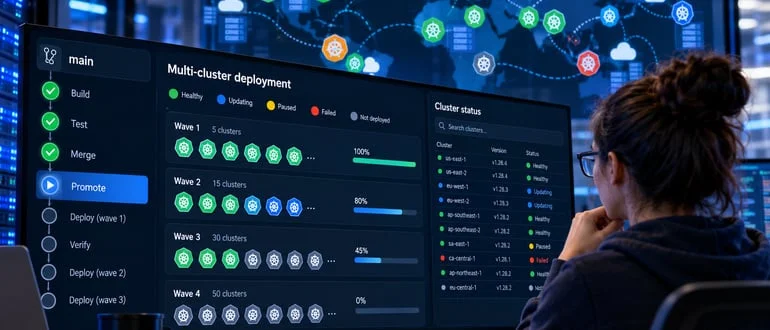
When a Git merge can update hundreds of production clusters, the hard part isn’t getting configuration there. It’s deciding when a release has earned the right to go further. That distinction between synchronization and promotion is becoming central to operating GitOps at fleet scale.
A platform engineer responsible for more than 200 production clusters across multiple clouds described a familiar setup: merging to the main branch triggered synchronization across the fleet. At five clusters, that model can be straightforward. Across hundreds, it turned a routine merge into a fleet-wide event with no gate between the change and broad deployment.
The team had one replica environment to catch problems before production. It took weeks to validate a release there, while propagation across the fleet took about an hour. That imbalance shaped how engineers worked: even when someone trusted a change, the scale of its potential impact made the merge button harder to press.
Fast synchronization leaves a decision gap
GitOps controllers are designed to reconcile clusters with the desired state stored in Git. That job matters, and doing it quickly can reduce operational friction. But synchronization alone doesn’t establish whether a release has passed the right checks, which cluster group should receive it next, or whether a failed verification should stop the rollout.
CI can build and test a release before it reaches the fleet. A deployment controller can then apply the configuration. In the example above, though, neither step governed advancement from one group of clusters to another. The team still needed a way to make that decision and keep a record of the evidence behind it.
Broadcasting a change and promoting it through stages are different operating models. In a broadcast, a merge can send the change everywhere. With staged promotion, a smaller group receives it first; the next group advances only after the current wave meets defined conditions. If a check fails, the remaining clusters can stay on their existing version while the team investigates.
That structure changes the practical risk of a release. It gives teams time to observe how a change behaves in production before extending it to a larger portion of the fleet. It also makes the rollout state easier to explain: operators can see what is running, which checks have passed and why progress has stopped.
Rollout sequencing is useful, but it isn’t the whole workflow
Several Kubernetes fleet tools already address the mechanics of distributing configuration and sequencing deployments. Argo CD ApplicationSets, Rancher Fleet, Open Cluster Management (OCM) and Karmada help teams manage configuration across clusters without maintaining a separate hand-written manifest for each one. Some also support staged rollouts and can pause when clusters become unhealthy.
Examples include ApplicationSet Progressive Syncs, rollout partitions in Rancher Fleet, and progressive ManifestWorkReplicaSet strategies in OCM. These capabilities can organize clusters into waves and apply health checks as changes move through them.
The remaining question is what the surrounding release process records and controls. A full promotion workflow needs to track a particular release, retain its verification results and use those results to decide where that release is allowed to go. Teams should examine which parts their current tools handle and which require additional process or tooling.
That distinction matters because a rollout sequence doesn’t automatically provide durable release history or a clear promotion decision. An operator may be able to pause a wave, yet still lack a single view of what version is deployed across the fleet, what evidence supports advancement, and what is blocking the next stage. Those are operational questions, not just deployment mechanics.
Visibility becomes a fleet control
For a fleet of hundreds of clusters, knowing the current state is part of controlling change. Engineers need to understand which version runs in each group, how it arrived there and what conditions must be met before another group updates. As a fleet approaches a thousand clusters, those answers need to be visible without piecing together status from scattered systems.
Release tracking also gives teams a way to reason about failure. If verification fails in one wave, the next groups can remain on their previous version. The team can inspect the issue and decide what to do with the release while the impact remains limited. Without that boundary, a failure may spread as quickly as the configuration can sync.
My read is that promotion will become a distinct layer in delivery systems as fleets grow. Git can continue to hold the desired state, and synchronization tools can continue to reconcile it across clusters. Promotion adds the control that determines when each group should adopt a new version, based on recorded checks and agreed requirements.
This doesn’t mean every team needs a separate product or an elaborate approval chain. The key is to make advancement explicit. A release should have a defined first group, criteria for moving to the next one and a reliable way to stop if those criteria aren’t met. The right implementation will depend on the fleet and the capabilities already in use.
Start with a wave and a stopping rule
Teams preparing for a fleet-wide rollout can begin with a small cluster group. Decide what must pass before the next group updates, and make the verification result visible alongside the release state. Then check that a failed result actually prevents the release from spreading to later waves.
That exercise tests more than whether a controller can pause. It shows whether the release process gives engineers enough information to act: which clusters are affected, which version is running, what failed and whether the fleet is still contained. A successful rollout should leave behind a useful record as well as updated clusters.
At small scale, a merge may feel like a sufficient release decision. At hundreds of clusters, it can conceal several decisions that deserve their own controls. Treating promotion as part of the delivery path gives teams a practical way to expand GitOps without asking a single merge to carry the full weight of fleet-wide confidence.



Discussion
Sign in to join the discussion.